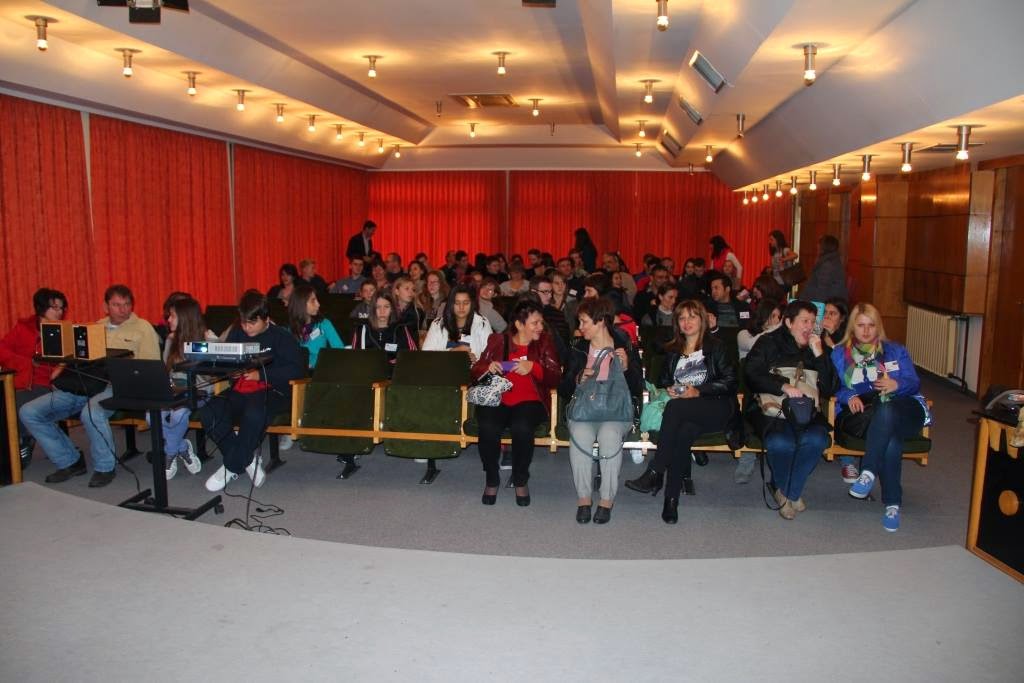
Ten partners of this Comenius project met in Alytus, Lithuania on the 11th
of March, 2014. All participants had been guided around three departments of Alytus Vocational Training Center. The guests had the opportunity to get acquainted with the various activities
students have at school. Partners visited among others the departments of nursing, beauty, and welder training. In addition, they were guided to Vilnius,
Trakai and interesting places in Alytus. The last day a cocktail
party took place. Everybody had a great
time while singing, dancing, and chitchating. The photos that follow are from this meeting.
Πέμπτη 10 Απριλίου 2014
Fourth Meeting in Paks, Hungary
The fourth meeting took place in Paks, 8-12th October, 2013. The groups from Austria, Bulgaria, Greece, Italy, Lithuania, Poland, Portugal, Slovakia, Sweden, and Turkey arrived on 8th of October. The official program started on the 9th of October at 9.00 a.m. The Headmaster greeted the guests and made a presentation on our school. The welcome program was followed by a working session at the school for both pupils and teachers. Pupils were asked to complete certain entertaining tasks, like preparing posters of their countries, and filling in questionnaires on Hungary. At midday after having lunch the group visited the Nuclear Power Plant, which plays a very important role in the life of the town as well as the school, and saw the exhibition at the visitors’ center and those over 16 could pay a visit to the visitors’ corridor with a tour guide and see the working area of the plant. In the rest of the afternoon the group returned to Paks and did a bit of sightseeing in the modern part of the town, the housing estate area, where they were admitted into the modern church designed by a famous Hungarian architect, and the basketball hall designed by the same person. Even though the weather did not favour us the hosting students and their guests had a great opportunity to get to know each other better and practice their English.
The second workday started off with a working session, but this time pupils were divided into 3 groups. Each group had pupils from different countries. One stayed at the school's library and worked with one of our IT teachers, the other group went to the local TV and radio station, and were informed about the program making procedures and technical devices of the stations, and they could try out the equipment and in the end they gave an interview! The third group had a chance to visit the local nursery, a kindergarten and an elementary school to get a glimpse at the educational work going on at the institutes and to shoot films and take photos, and make material that could be used for a cooperative product. In the rest of the afternoon we went sightseeing to the old part of the town and visited the Roman Ruins, Lussonium, nearby Paks and the Roman exhibition at the local museum, where pupils could learn about the past of the area and could dress up as Romans. The evening continued with an international pupils’ party, where our guests were asked to perform something, a dance or a song, so the Hungarian pupils could learn a few things about the culture of their visitors. The Hungarian pupils also prepared a folk dance and a folk music performance.
The last day started off with a visit to the Major’s Office, to the Town Hall reception followed by a walk at the riverside. After the morning working session at school they had lunch and we travelled to the seat of Tolna county, Szekszard, to do a sightseeing tour, and the teachers had chance to try the wine this region is famous for. To learn more about Hungarian folk culture we went to Decs and saw the folk museum, tasted a speciality of the area, pastry with sour cream and we even danced to folk songs and folk music together. In the evening teachers had a farewell dinner at one of the cellars in Paks, the pupils spent their time together.
October, 12 was the day the guests departured. All in all the meeting fulfilled its aim. Pupils worked together, communicated in English, learned about each other’s cultures. The teachers could also discuss some important issues about the project work.
Below are some photos taken during the meeting.
The second workday started off with a working session, but this time pupils were divided into 3 groups. Each group had pupils from different countries. One stayed at the school's library and worked with one of our IT teachers, the other group went to the local TV and radio station, and were informed about the program making procedures and technical devices of the stations, and they could try out the equipment and in the end they gave an interview! The third group had a chance to visit the local nursery, a kindergarten and an elementary school to get a glimpse at the educational work going on at the institutes and to shoot films and take photos, and make material that could be used for a cooperative product. In the rest of the afternoon we went sightseeing to the old part of the town and visited the Roman Ruins, Lussonium, nearby Paks and the Roman exhibition at the local museum, where pupils could learn about the past of the area and could dress up as Romans. The evening continued with an international pupils’ party, where our guests were asked to perform something, a dance or a song, so the Hungarian pupils could learn a few things about the culture of their visitors. The Hungarian pupils also prepared a folk dance and a folk music performance.
The last day started off with a visit to the Major’s Office, to the Town Hall reception followed by a walk at the riverside. After the morning working session at school they had lunch and we travelled to the seat of Tolna county, Szekszard, to do a sightseeing tour, and the teachers had chance to try the wine this region is famous for. To learn more about Hungarian folk culture we went to Decs and saw the folk museum, tasted a speciality of the area, pastry with sour cream and we even danced to folk songs and folk music together. In the evening teachers had a farewell dinner at one of the cellars in Paks, the pupils spent their time together.
October, 12 was the day the guests departured. All in all the meeting fulfilled its aim. Pupils worked together, communicated in English, learned about each other’s cultures. The teachers could also discuss some important issues about the project work.
Below are some photos taken during the meeting.
Second Meeting in Coimbra, Portugal
In January 2013, the small village of Almalaguês hosted the second meeting. The weather was rainy but with all the excitement due to the arrival of some 60 new people to this place the rain looked like sun shine. Then here they came. Some were blond and tall, other short and black haired. They suited all tastes and wishes. Our pupils were fascinated even if the language was a barrier sometimes. But soon we discovered that the smile and the look in someone's eyes is the same everywhere on the world. And pupils started to gather. They gathered around tastes, clothes, music, food and both brief and eternal friendships were born. Even if some are FB friendships... We visited Almalaguês, Coimbra and the roman city of Conimbriga. Only the damn weather stopped us from going to Figueira da Foz, to the so called beach of Coimbra, some 40 km from here. And some more ideas for the project were also born. We decided about thematics, schedules and some objectives.
More than one year ago has gone and those tall and blonde and short and black haired are still remembered in the little village of Almalaguês were some hearts were broken and some tears were also shared.
The international party of the meeting was a particularly successful event!
| During a walk in the old town of Coimbra. |
First Meeting in Matera, Italy
The first meeting of the project took place in Matera, Italy, 16-20 October 2012. This was a meeting with no pupils as it was a preparatory meeting. During the meeting we decided what would be the official logo of the program. The logo was designed by a pupil of the Slovakian partner:
In addition, the partners laid out the priorities and the activities that should take place in the upcoming meetings. The photos below had been taken during the meetings.
Δευτέρα 17 Μαρτίου 2014
Welcome!
This is the official web page of the "COOPERATIVE LEARNING USING NEW MEDIA, teenagers in action on Web Radio and TV—A new pedagogical approach to an integrate Europe" program. The program is implemented by 12 school and is founded by the The Comenius Program. Some of the schools that participate in the program are:
- IIS "G. B. Pentasuglia", Italy
- is a technical high school with about 1,000 students and 120 teachers. The school offers courses in informatics, mechganical engineering, electrical engineering, chemistry, as well as the standard liceo (lyceum) courses for students willing to pursue their studies at universities. Graduates of this school can immediately enter the workforce although around 70% of then pursue their studies at universities. The school is located in Matera, town of around 50,000 inhabitants. Matera is included in the UNESCO World Heritage List because of Sassi and the Park of the Rupestrian Churches. Matera is located in South Italy, 40 Km off the coast the Gulf of Taranto, an Ionian Sea gulf, in Southern Italy. The town's altitude is 500 m.
- 2nd Gymnasium of Xanthi, Greece
- is a standard Greek middle school. The 2ο Γυμνάσιο Ξάνθης has around 300 students and 40 teachers. Students study for three (3) years and their studies is part of the nine year compulsory education (six years in elementary school plus three years in middle school). Students are taught mathematics, ancient and modern Greek, physics, chemistry, biology, computers, etc. After graduation, students can follow high school (γενικό λύκειο, that is, general lyceum) or some vocational education school (επαγγελματικό λύκειο, that is, vocational lyceum, or some επαγγελματική σχολή, that is, vocational school). In the preevious years, a large number of students who followed general lyceum were pursuing their studies at universities and institutions similar to UK's polytechnics. Now, there are some plans to change this. The school is located in Xanthi, a town of roughly 55,000 people. Xanthi is famous among Greeks for its carnival and the so-called old-town festival.
- Obchodná akadémia, Slovakia
- is a secondary vocational school in Topoľčany, a town of about 30,000 inhabitants, situated in the south-western part of Slovakia. The school has 450 students altogether. The youngest students are 15 years old and the oldest ones are 19 years old. There are 34 fully qualified teachers employed in the school. The work environment is very friendly to students, teachers and other staff. The school is equipped with special ICT chttps://www.google.gr/search?q=%E2%80%8Bhttp%3A%2F%2Fweb-radio-tv.blogspot.gr%2F&ie=utf-8&oe=utf-8&aq=t&rls=org.mozilla:en-US:official&client=firefox-a&channel=fflb&gfe_rd=cr&ei=JT9GU7uGBM_a8geuwoD4CQlassrooms and two language labs. The school gives support to a further development of students, which is seen as an opportunity to transform the traditional methodologies in the different subjects, towards newer ones, based on the use of new information technologies and communication. After graduation students gain the qualification in economics but language and general education is provided as well. All students learn two foreign languages. Students can choose betweem English, German or French. Moreover, the school is state examination center for type-writing and ECDL courses which are also offered to students.
- Mersinli Endüstri Meslek Lisesi, Turkey
- that is, the Mersinli Industrial & Technical High School is a vocational, technical high school since 1981. The school has five main departments: chemistry, information technology, electricity and electronic technology, mechanics and metal technology. The school has a four-year teaching program. After graduation, students can manage to work in factories or hospitals. Some of them pursue their studies at universities. There are 125 teachers and 1800 students. The school has been awarded prizes, in many subjects, by TÜBİTAK, that is the scientific and technological research council of Turkey. The school is also a local branch of the Cisco Networking Academy. The school is located in İzmir, which is the third biggest city in Turkey.
- ESZI, Hungary
- is a vocational secondary school located in the small town of Paks with a population of around 18000 people. It is one of the first company-operated schools in Hungary started by the Paks Nuclear Power Plant in 1986. Since 2001 it operates as a general secondary school. The school has over 650 students between the age 14-20, mainly boys and about 70 teachers. The students can specialise in informatics, electrical engineering, electronics, mechanical engineering, environment protection, water management, economics and business management. Many school graduates are employed at the Nuclear Power Plant. The school is involved in several international projects, exchange programs. It hosted the International FESTO Cup, it participated in a Comenius 1.2 Language Project, a Comenius 1.1 School Partnership Project, Comenius Multilateral School Partnerships, and a Leonardo project. The school is the member of the European as well as the Hungarian Network of Innovative Schools, taking part in different international programs, such as ThinkQuest, E-twinning etc.
- Bundeshandelsakademie Laa, Austria
- is a secondary vocational school in Laa an der Thaya, a small town inhabited by roughly 6.000 people, situated near the border with the Czech Republic. The region is famous for its wine. The school has about 300 students and 30 teachers. The youngest students are 14 years old and the oldest ones are 19 years old. Graduates of this school can immediately enter the workforce and also pursue their studies at universities.
- Instituto de Almalaguês, Portugal
- is a private school that belongs to GPS the largest group of private schools in the Iberian Peninsula. The school started its activities in 1992 and has what is called here the 2nd, 3rd cycles of teaching as well as the secondary. We have kids from the age of 10 up to 18 years old. There are about 300 pupils and 25 teachers in a school that tries to be a family for our kids.
- Kocho Chestemenski Primary School
- is well-known for its traditional approache to teaching based on the experience and professionalism of the people who work here. The school was founded in 1941 and is located in the second largest town of Bulgaria. Currently, the school employs 37 teachers and has about 400 pupils aged from 5 to 14. These pupils have an acceptable knowledge of English, while some of them have a very good command of the English language. The school tries to combine theory with practice while preparing pupils to become good citizens with intercultural competences. Equal opportunities and means are given to all pupils. In this school, education is the result of cooperation between teachers, parents and the public authorities.
The aim of this project is to create a video web-channel, which will host videos produced by pupils of the participating schools, as well as a shout-cast channel, which will host radio shows produced by pupils. Just press the button below to start listening to the web-radio program.
Εγγραφή σε:
Αναρτήσεις (Atom)